Five Ways to Make Saturday Clothes Look Like Sunday Clothes
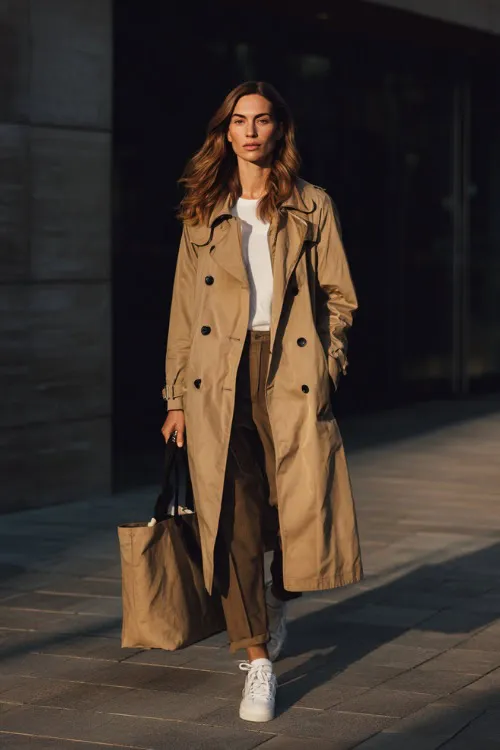
Photo: effortlessly chic woman white sneakers dark jeans trench coat street style, via www.fromtheguestroom.com
The most stylish women we know are not the ones with the largest closets. They are the ones who understand a simple piece of arithmetic: polish is a product of pairing, not purchasing. A gray sweatshirt is a slouch. A gray sweatshirt with tailored trousers and a leather loafer is a mood. Same sweatshirt. Different math.
Here are five equations that turn the American casual uniform — denim, sneakers, knitwear, the humble tee — into something with genuine presence. No shopping required.
1. The Dark Denim Exchange
Your light-wash, distressed jeans are weekend currency. But swap in a dark indigo pair with a clean hem — no fraying, no whiskering — and the same white tee and leather jacket suddenly read intentional. Dark denim behaves like a trouser. It holds structure, flatters nearly every palette, and signals that effort occurred, even when none did. This is the single highest-leverage swap in casual dressing.
2. The Sneaker Downgrade (Yes, Downgrade)
Counterintuitive, but true: chunky athletic sneakers read sporty, while a slim leather sneaker — think a minimal white or off-white pair — reads considered. The difference is volume. Sleek sneakers have a lower visual weight, which lets the rest of your outfit speak. Pair them with a trench, straight-leg jeans, and a striped knit, and you have the unofficial uniform of every well-dressed woman in a Midwestern airport.
3. The Half-Tuck Doctrine
An untucked sweater over jeans is comfortable and shapeless. A fully tucked sweater is trying too hard. The half-tuck — front hem gathered loosely into the waistband, back left to fall — creates a waistline, shows a belt if you wear one, and adds the suggestion of ease. It works on crewnecks, button-downs, and fine-gauge knits alike. It is the two-second gesture that separates 'threw this on' from 'thought about this.'
4. The Structured Bag Rule
Nothing de-elevates an outfit faster than a slouchy nylon tote worn crossbody like a duffel. Conversely, nothing elevates faster than structure. A structured leather bag — top-handle, clean lines, a color deeper than black if you are feeling brave — imposes polish on everything around it. Wear your softest cashmere and oldest jeans, add a structured bag, and watch the entire look straighten its posture.
5. The Third-Piece Principle
Two casual pieces make an outfit; a third makes a look. Over a tee and jeans, add one structured element: a longline coat, a tailored vest, a crisp shacket in wool. The third piece is what transforms a base into a composition. In winter, this is effortless — a camel coat over anything is an outfit. In summer, a linen blazer or an unstructured jacket does the same work.
The One Borrowed Category Rule
If you remember nothing else, remember this: every polished-casual outfit borrows exactly one element from a dressier wardrobe zone.
The zones, roughly: casual (sweats, athletic wear, distressed denim), everyday (tees, jeans, knitwear), and dressy (tailoring, silk, refined leather, heels). A great casual look steals one item from the dressy zone — silk trousers with a sweatshirt, a blazer over a hoodie, heeled boots with straight jeans — and lets the contrast do the work.
One borrowed element reads deliberate. Two reads confused. Three and you are simply dressed up. The discipline of the single borrow is what keeps the look grounded, modern, and unmistakably American in its ease.
Polish, it turns out, was in your closet all along. It was just waiting for better company.