When Less Demands More: The Quiet Discipline of a True Capsule Wardrobe
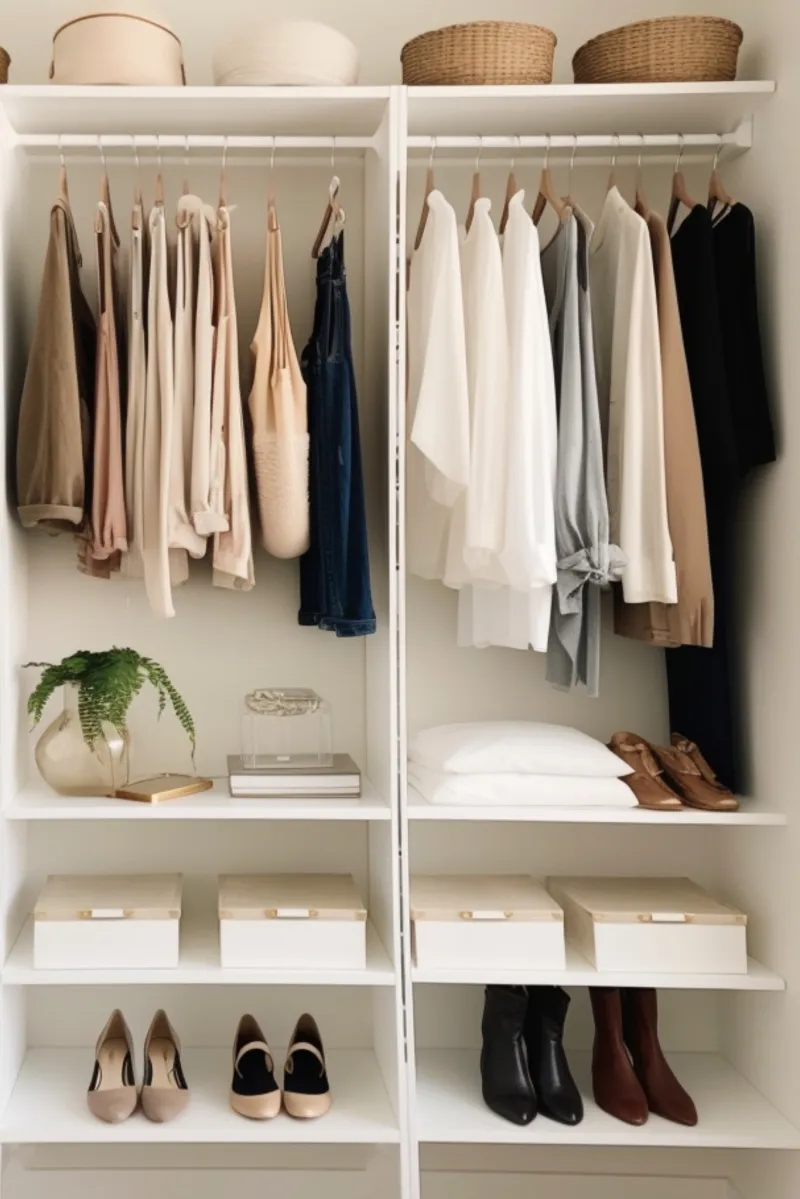
Photo: minimalist wardrobe elegant capsule clothing neatly arranged closet neutral tones, via www.stylebysavina.com
There is a particular kind of optimism that arrives each January, or perhaps after a long weekend of closet reorganization: the belief that owning fewer clothes will, somehow, make everything easier. The capsule wardrobe has been celebrated in lifestyle columns and minimalist manifestos alike as the antidote to decision fatigue, overconsumption, and the chronic frustration of standing before a full closet feeling as though there is nothing to wear.
And yet, for many women, the experiment ends quietly. The edited wardrobe feels sparse rather than refined. The gaps are glaring. The pieces that remain are not necessarily the right ones — they are simply the ones that survived the purge.
The promise of the capsule wardrobe is real. But its execution requires something most guides fail to name directly: reduction without elevation is merely deprivation.
The Paradox at the Center of Minimalist Dressing
Here is what the arithmetic of capsule dressing actually demands. When a wardrobe contains forty pieces, a mediocre blazer is forgivable. It is one option among many, and on the days it disappoints, another layer waits in the wings. Reduce that wardrobe to fifteen pieces, and that same blazer becomes a liability. It will be reached for regularly, photographed, remembered, and judged — by others, and more critically, by you.
This is the paradox: fewer clothes do not lower the standard. They raise it considerably.
The women who build capsule wardrobes that genuinely function understand this instinctively. They do not approach the exercise as subtraction. They approach it as curation — a word that implies both selectivity and expertise. A curator does not simply remove objects from a gallery; she considers what remains, how each piece relates to its neighbors, and what the collection communicates as a whole.
The Most Common Mistake: Editing Quantity, Not Quality
When the capsule concept first gained mainstream traction in the United States, it was often reduced to a number. Thirty-three pieces. Ten items. A single carry-on's worth of clothing. The numerical framework is useful as a constraint, but it has also produced a particular kind of failure mode.
Women who edit their wardrobes by quantity alone tend to keep what they already own, simply in smaller amounts. The result is a closet full of pieces that were never quite right — purchased impulsively, accepted as gifts, or retained out of guilt — now elevated to daily rotation through sheer necessity.
Fit is the first casualty of this approach. A garment that fits imperfectly in a crowded wardrobe remains imperfect in a sparse one. The difference is that in a sparse wardrobe, there is nowhere to hide. Poor fit reads immediately and persistently, undermining even the most thoughtful outfit construction.
Quality of fabric follows closely. Synthetic blends that pill after a season, cotton that loses its shape after washing, structured pieces whose interiors collapse — these flaws are manageable curiosities in a large wardrobe. In a capsule context, they become defining characteristics of how you present yourself to the world.
A Framework for Earning a Place in the Closet
The question every capsule wardrobe builder must learn to ask is not do I like this? but rather does this piece justify its permanent presence?
This reframing shifts the evaluation from emotional to functional — and it is a meaningful distinction. Liking something is easy. Justifying its ongoing tenancy requires a more rigorous accounting.
Consider four criteria when assessing whether a piece genuinely belongs:
Versatility across contexts. In a minimal wardrobe, a piece must perform across multiple settings. A blouse that works only for formal occasions will sit idle for the majority of the year. The most valuable pieces in a true capsule are those that transition — from a morning meeting to an evening dinner, from a casual Saturday to a professional Monday — with minimal effort and maximum integrity.
Fit that requires no apology. This means fit as it exists today, not after alterations you have been meaning to schedule, and not in a size you are working toward. A capsule wardrobe is not aspirational; it is operational. Every piece must fit and flatter the body you currently inhabit.
Construction that withstands repetition. Because capsule pieces are worn frequently, they must be built to endure it. Examine seams, check for reinforced stress points, consider how the fabric responds after washing. A well-constructed garment at a moderate price will always outperform a poorly constructed one at a premium price point.
Alignment with your actual life. This is perhaps the most underestimated criterion. A wardrobe built around an imagined lifestyle — the gallery openings, the weekend trips to Nantucket, the office presentations — will fail the woman whose actual week involves school pickup, client calls from home, and Saturday farmers' markets. Elegant dressing is not about aspiration. It is about meeting your real life with intention and beauty.
Investing Differently, Not Necessarily More
Building a capsule wardrobe does not require a dramatic budget increase, though it does require a reallocation of how that budget is spent. The shift is from breadth to depth: fewer purchases, each considered more carefully and priced more honestly.
This often means accepting a slower pace of acquisition. Rather than filling gaps immediately with whatever is available and affordable, the practiced capsule builder identifies what is missing, defines precisely what that piece must do, and waits for the right version of it. This patience is not a personality trait some women possess and others do not. It is a discipline, and it can be cultivated.
It also means developing a more sophisticated relationship with cost-per-wear — a calculation that reframes a $300 cashmere sweater worn twice a week for five years as considerably more economical than a $40 acrylic version replaced annually.
The Wardrobe as a Reflection of Clarity
At its best, a capsule wardrobe is not an exercise in self-denial. It is an expression of self-knowledge. The woman who has built one well knows what she values, understands how she moves through her days, and has made peace with the difference between what she wishes she wore and what she actually reaches for.
There is a quiet confidence that comes from opening a closet and finding only things that fit, function, and feel right. It is not the confidence of abundance. It is something more durable — the confidence of having made good decisions, deliberately and without compromise.
That, ultimately, is what the capsule wardrobe demands. Not fewer clothes. Better choices.