Dressed From the Inside Out: The Psychology of a Style That Is Entirely Your Own
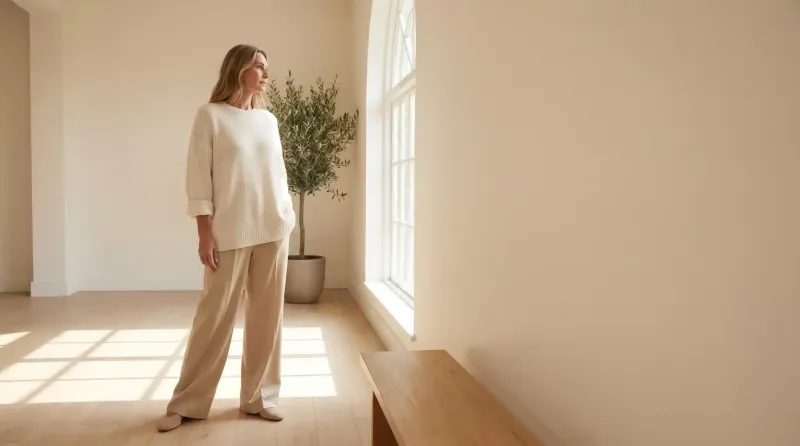
Photo: confident elegant woman in minimalist outfit standing alone in sunlit room, via www.copenhagenfashionsummit.com
There is a particular kind of woman you notice the moment she enters a space. She is not necessarily wearing the loudest color or the most recent runway interpretation. She is not performing. She is simply, and completely, herself—and the room adjusts accordingly.
This quality, which fashion editors have long attempted to bottle and brand strategists have tried endlessly to manufacture, resists easy definition. It is not wealth. It is not access to exceptional pieces. It is something quieter, and considerably more powerful: the unwavering knowledge of who she is when she gets dressed in the morning.
The Myth of the Trend-Forward Wardrobe
American fashion culture has long operated on a seductive promise—that the right purchase, the right season, the right silhouette will unlock a version of yourself that feels fully realized. The industry's machinery depends on this belief. And yet, the women most frequently cited as style icons—those whose photographs circulate decades after they were taken—were rarely early adopters of whatever was fashionable at the time.
They were, instead, deeply consistent. Katharine Hepburn wore wide-leg trousers when women were expected in skirts. Carolyn Bessette-Kennedy built an aesthetic of deliberate restraint at a moment saturated with maximalism. Their authority did not come from alignment with the moment. It came from alignment with themselves.
New York-based stylist Margaux Ellery, who works with executives and public figures across the East Coast, describes this phenomenon plainly: "Trend-chasing is essentially outsourcing your identity. The women I work with who feel most confident in their clothes are the ones who have done the internal work first. They know what they value, what they want to communicate, what makes them feel capable. The clothes become an expression of that—not a substitute for it."
What Neuroscience Reveals About Self-Assured Dressing
The connection between clothing and psychological state is not merely anecdotal. Researchers at Northwestern University coined the term "enclothed cognition" to describe the systematic influence garments have on the wearer's psychological processes. Their findings suggest that what we wear affects not only how others perceive us, but how we perceive ourselves—our cognitive performance, our confidence thresholds, and our willingness to inhabit authority.
More recent work in social psychology supports an adjacent idea: that consistency in self-presentation signals psychological integration to observers. In other words, when a person dresses in a manner that feels coherent and intentional—rather than assembled from competing external signals—those around them register that coherence as confidence, competence, and trustworthiness.
This is worth sitting with. The most persuasive thing you can wear to a negotiation, a first meeting, or a dinner where the stakes feel high may not be the season's most authoritative silhouette. It may simply be the outfit in which you are most fully yourself.
Developing Your Internal Compass
Building what stylists sometimes call a "confidence uniform"—the personal aesthetic vocabulary that requires no external validation—is less about curation and more about excavation. It begins with honest inquiry rather than shopping.
Consider the moments in your life when you have felt most at ease in your own skin. What were you wearing? Not what was objectively beautiful, but what allowed you to move through the world without self-consciousness—without the low hum of doubt that accompanies an outfit chosen for approval rather than expression.
Ellery recommends a practice she calls the "three-second rule" with her clients. "When you put something on in the morning, give yourself three seconds before you look in the mirror. Notice what you feel before you see. That sensation—ease, energy, hesitation, flatness—is data. Over time, it becomes a remarkably reliable guide."
This internal attunement is something that develops gradually, and it requires a certain willingness to disappoint. Dressing with conviction means, on occasion, wearing something that others might not immediately understand or applaud. It means resisting the magnetic pull of what is currently everywhere in favor of what is consistently, recognizably you.
The Elegance of Refusal
There is a particular form of elegance that lives not in acquisition but in restraint—in the deliberate choice not to follow a direction that doesn't serve your particular story. This is perhaps the most undervalued skill in contemporary dressing.
The ability to look at a trend—however well-executed, however widely embraced—and say, with genuine equanimity, that is beautiful, and it is not mine, is a form of self-knowledge that most of us spend years developing. It requires that you have something to measure against: a clear enough sense of your own aesthetic that you can recognize when something falls outside it.
This is not rigidity. The most elegantly dressed women evolve. Their style deepens, shifts in proportion, grows more refined with time. But the evolution is organic—it emerges from within rather than being imported wholesale from outside. The thread of continuity remains.
Chicago-based wardrobe consultant Diane Sato, who specializes in working with women navigating major life transitions, frames it this way: "I often see women in their forties and fifties who are just beginning to dress for themselves—sometimes for the first time. There's a freedom in that, but also a kind of grief for the years spent performing for an audience. The work is always the same: getting quiet enough to hear what you actually want, and then having the courage to wear it."
Style as Autobiography
At Little Étoile, we have always held that true elegance is not a costume. It is not the perfect execution of someone else's vision of what a well-dressed woman looks like. It is the visible expression of an interior life—curated, considered, and entirely one's own.
The most compelling wardrobes are, in this sense, autobiographical. They accumulate meaning over time. They carry the evidence of choices made with intention: the silk blouse purchased not because it was trending but because it felt, inexplicably and immediately, like something you had always owned. The structured coat that has accompanied you through a decade of significant moments and still feels precisely right.
These pieces are not simply clothing. They are the architecture of a self-narrative—and they communicate that narrative to every room you enter, often before you have said a single word.
The invitation, then, is not to find your style. It is to recognize that it has been present all along, waiting beneath the noise of trends and expectations and the accumulated weight of dressing for everyone but yourself.
Go quiet. Listen carefully. Then dress accordingly.