The Foundation Is the Statement: Rethinking What 'Basic' Really Means
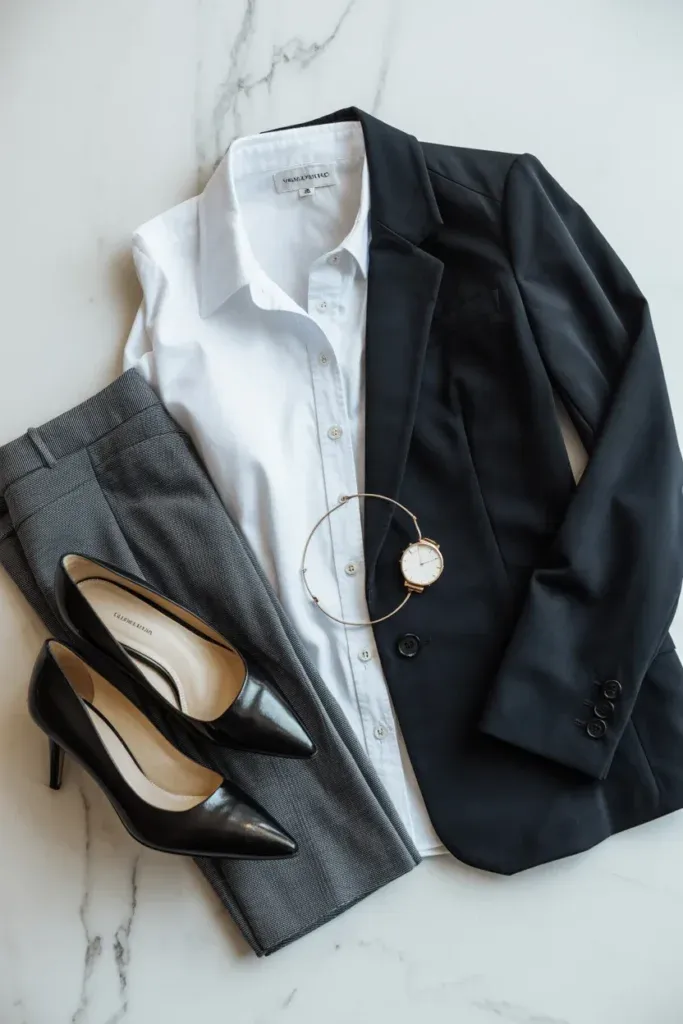
Photo: elegant white button-down shirt and tailored trousers flat lay on marble surface, via capsulewardrobestyle.com
There is a particular kind of exhaustion that comes from standing in front of a closet full of clothes and feeling, somehow, as though you have nothing to wear. For many women, the culprit is not a shortage of pieces — it is an abundance of uninspired ones. Somewhere between the rise of the capsule wardrobe philosophy and the mass-market interpretation of minimalism, a quiet injustice was committed against the garments we reach for most.
We began calling them "basics." And in doing so, we began expecting very little of them.
How Minimalism Mislabeled the Wardrobe's Most Important Pieces
The capsule wardrobe concept, popularized in the 1970s by London boutique owner Susie Faux and later championed by Donna Karan's iconic Seven Easy Pieces collection, was never intended to be a prescription for mediocrity. Its original promise was liberating: invest in fewer, better things, and dress with intention rather than impulse. The philosophy was elegant in its simplicity.
Yet somewhere between that founding vision and today's fast-fashion interpretations, the concept became distorted. Capsule wardrobe guides began circulating with images of limp cotton tees, shapeless trousers, and blazers that seemed designed to disappear rather than to define. The message, however unintentional, was clear: save your investment for the statement pieces. The basics will handle themselves.
This is the myth worth dismantling.
Consider how you actually dress. On most mornings — whether you are heading into a Manhattan office, attending a school board meeting in suburban Chicago, or navigating a full day of client calls from your home in Los Angeles — you are reaching for exactly those so-called basics. The white button-down. The well-cut trouser. The neutral blazer that bridges every occasion. These are not the supporting cast of your wardrobe. They are, in practice, its leading players.
The Case for Beautiful Foundations
New York-based stylist Margaux Delacroix works primarily with professional women who describe themselves as "not really fashion people" — a phrase she finds revealing. "When a client says that, what they usually mean is that they've been told their everyday needs don't deserve beautiful clothes," she explains. "But the woman who wears a white shirt five days a week needs that shirt to be extraordinary far more than she needs a sequined dress for one occasion a year."
Delacroix's approach begins at the foundation. Before any conversation about color, trend, or occasion dressing, she asks clients to examine the quality and cut of their most-worn pieces. Invariably, those pieces have received the least investment.
"There's a psychological pattern at play," she notes. "Women feel guilty spending on something they perceive as ordinary. They feel they need to justify a purchase by its specialness. But the most elegant wardrobes I've encountered belong to women who reversed that logic entirely."
The reversal she describes is simple but transformative: direct the highest portion of your clothing budget toward the pieces you wear with the greatest frequency. A white shirt worn three times a week over the course of a year earns its quality far more than a cocktail dress worn twice.
What Elevated Basics Actually Look Like
Rethinking basics as worthy of genuine design consideration does not require abandoning restraint. On the contrary, it demands a more discerning eye — one attuned to the details that separate a forgettable garment from one that quietly commands attention.
For a white shirt, this means examining the weight and opacity of the fabric, the precision of the collar construction, the placement of the buttons, and whether the seams fall correctly on the shoulder. A truly exceptional white shirt — from brands such as Equipment, Nili Lotan, or Lafayette 148 New York — carries a quiet authority that no amount of accessorizing can manufacture from a lesser base.
For tailored trousers, the conversation turns to drape. How does the fabric move? Does the waistband sit without gaping? Is the leg cut in a proportion that elongates rather than shortens? These are not superficial concerns. They are the difference between a trouser that reads as intentional and one that simply reads as present.
Neutral blazers — perhaps the most misunderstood of all wardrobe foundations — deserve particular attention to structure. A blazer that holds its shape through a long day, that transitions cleanly from a morning meeting to an evening dinner without requiring a change, is a garment worth genuine investment. The shoulder seam, the lapel width, the lining quality: these details are invisible when done well and glaringly obvious when neglected.
Reframing Value in Your Wardrobe
Stylist and wardrobe consultant Petra Voss, who works with clients across the Pacific Northwest, encourages a reframe she calls the "cost-per-wear audit." The exercise is straightforward: divide the price of a garment by the realistic number of times you will wear it in a year. A $400 blazer worn 80 times costs $5 per wear. A $150 blouse worn twice costs $75 per wear.
"Once women see the numbers, the conversation changes completely," Voss says. "They stop feeling extravagant for spending on a beautiful trouser and start questioning why they spent so much on things they never actually reach for."
This is not an argument for reckless spending. It is an argument for intentional spending — for directing resources toward the garments that genuinely serve your life, rather than those that serve a fantasy version of it.
Dressing with Quiet Confidence
At Little Étoile, we believe that elegance is not a costume reserved for exceptional occasions. It is a daily practice — one that begins with the very first decision you make each morning. When the pieces you reach for most are crafted with care, cut with precision, and chosen with intention, that practice becomes effortless.
The white shirt is not a blank canvas waiting for something more interesting to arrive. It is, in the right hands and with the right construction, one of the most powerful garments in existence. The tailored trouser is not filler. The neutral blazer is not background.
They are the stars of a truly elegant wardrobe — and they deserve to be dressed accordingly.