The True Cost of Cheap: Why One Exceptional Piece Outspends a Closet Full of Compromises

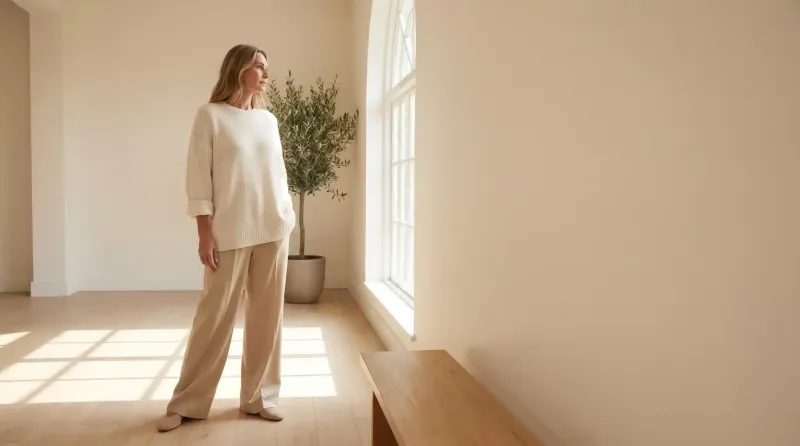
Photo by Photo by Jeppe Mønster on Unsplash on Unsplash
There is a particular kind of fatigue that arrives after years of bargain-hunting. The closet is full, yet nothing feels quite right. The blouse purchased on impulse loses its shape after a season. The coat that seemed like a steal reveals its seams by February. And so the cycle continues — more purchasing, more disappointment, more clutter that somehow never resolves itself into an actual wardrobe.
The counterintuitive truth that seasoned dressers eventually arrive at is this: spending less, repeatedly, is often the most expensive approach to building a closet. The woman who invests in one impeccably constructed cashmere coat may spend more in a single transaction than the woman who cycles through three fast-fashion alternatives over the same period — but the numbers, examined honestly, rarely favor the latter.
The Arithmetic Nobody Does at the Register
Consider a simple example. A well-constructed wool blazer from a reputable American or European house might carry a price tag of $400 to $600. That figure, standing alone, can feel prohibitive. But worn twice a week across three years — a modest estimate for a piece of genuine quality — the cost per wear drops below $1.50. The $80 alternative, worn a dozen times before pilling renders it unwearable, costs nearly $7 per wear.
This calculation, known informally as cost-per-wear, is not a new concept. What is less frequently discussed is the secondary cost of the cheaper option: the time spent shopping for its replacement, the mental energy devoted to making it work in an outfit, and the subtle dissatisfaction that follows a woman through her day when she knows, instinctively, that something is off.
True investment dressing is not about luxury for its own sake. It is about understanding that quality, when chosen wisely, eliminates the perpetual transaction.
The Confidence That Cannot Be Discounted
Beyond the spreadsheet logic lies something harder to quantify but no less real. There is a particular quality of confidence that arrives when a woman wears something that fits her well, drapes correctly, and has been made with enough care that it holds its form through a full day of living. This is not vanity. It is the embodied experience of wearing something that does not require constant adjustment, second-guessing, or apology.
Psychologists who study the relationship between clothing and self-perception have long observed that what we wear influences not only how others perceive us, but how we perceive ourselves — a phenomenon sometimes called enclothed cognition. The implication for dressers is significant: the piece you reach for with certainty, the one that requires no convincing, is doing invisible work on your behalf long before you walk into a room.
An investment piece earns its price, in part, through this daily dividend.
Identifying the Purchases That Actually Justify the Price
Not every expensive garment is an investment, and this distinction matters enormously. A sequined cocktail dress at a steep price point may be beautiful, but if your life offers few occasions for it, the cost-per-wear calculation collapses quickly. True investment dressing requires an honest reckoning with the life you actually inhabit — not the aspirational version of it.
The pieces most likely to justify a higher outlay share several characteristics:
Versatility across contexts. A fine merino turtleneck moves from a weekend morning to a business meeting to an evening dinner without effort. The more scenarios a piece can navigate, the more valuable it becomes per occasion.
Construction that withstands time. Look for flat-felled seams, substantial lining, and fabric with enough weight to hold its silhouette. These details are not incidental — they are the infrastructure of longevity.
A silhouette that is neither aggressively trendy nor boringly generic. The sweet spot is a design with enough character to feel considered, but enough restraint to remain relevant across several years. Classic, in other words, without being invisible.
Emotional resonance. This criterion is often dismissed as impractical, but it is among the most reliable. If a piece makes you feel genuinely better when you wear it — more yourself, more capable, more present — that feeling will return every time you reach for it. That is not a small thing.
The Categories Worth Prioritizing
For the woman beginning to shift her approach toward intentional investment, a few categories offer the most reliable return.
Outerwear is, perhaps, the single most visible investment available. A coat is worn over everything, seen by everyone, and experienced every day through the colder months. Quality here is immediately perceptible — to you and to others.
Footwear repays quality with both longevity and posture. A well-constructed leather shoe or boot, resoled as needed, can accompany a woman for a decade. Its cheaper counterpart rarely survives a second winter.
Foundational knitwear — the cashmere crewneck, the fine merino cardigan — forms the quiet architecture of a working wardrobe. These pieces appear in photographs, in meetings, and in memories precisely because they are worn so often. Their quality, or lack of it, becomes intimately familiar.
Structured bags occupy a category of their own. A well-made leather bag ages visibly and beautifully, acquiring a patina that mass-produced alternatives simply cannot replicate. It is also the one item that accompanies nearly every outfit, making its daily presence either an asset or a liability.
A Different Way of Shopping
Shifting toward investment dressing is less a financial decision than a philosophical one. It requires slowing down the acquisition reflex — that familiar pull toward something new, something affordable, something that might work — and replacing it with a more deliberate question: Will I still want to wear this in five years?
This question is a reliable filter. It does not eliminate all impulse, but it reframes it. The purchase that survives this inquiry tends to be the one that earns its place in a closet rather than simply occupying space within it.
At Little Étoile, we believe that a wardrobe built on fewer, better choices is not a wardrobe of deprivation. It is a wardrobe of abundance — the abundance that comes from always having exactly what you need, in a form that never requires an apology. That, ultimately, is the return no discount can offer.