Dressing Against the Current: The Quiet Power of a Style That Refuses to Follow
There is a particular kind of exhaustion that arrives each season alongside the new lookbooks. The color of the year. The silhouette that is suddenly everywhere. The accessory that was obscure last March and ubiquitous by October. Fashion, at its most commercial, operates like a conveyor belt — and the implicit message is always the same: keep up, or fall behind.
But what if falling behind was never the risk? What if the women who appear most effortlessly dressed have simply chosen to step off the belt entirely?
The Illusion of Relevance
The trend cycle is not, at its core, about aesthetics. It is about commerce. Seasonal collections exist to create desire, to manufacture the feeling that what you currently own is insufficient, and that relevance is something you must continually repurchase. This is not cynicism — it is the openly stated logic of fast fashion and, increasingly, of the broader industry that feeds it.
What this cycle produces, for the woman who participates in it earnestly, is a wardrobe that feels simultaneously overfull and incomplete. There is always something missing because something is always being retired. The blush that was everywhere two springs ago now reads as dated. The wide-leg trouser that felt so of-the-moment last fall is already being displaced by something narrower, or wider, depending on which direction the pendulum has swung.
Timelessness, by contrast, is not subject to this calculus. A well-cut camel coat does not expire. An ivory silk blouse does not require a trend report to justify its presence in your closet. These pieces exist outside the seasonal machinery, and that independence is precisely what makes them powerful.
Neutrals as a Form of Refusal
To build a wardrobe anchored in neutrals — in the creams, taupes, warm grays, and soft blacks that have served elegant dressing for generations — is to make a choice that the trend cycle cannot easily commodify. Neutrals do not belong to a season. They do not carry the fingerprint of a particular year. They resist the very mechanism that makes fast fashion profitable.
This is not a passive choice. It requires intention. When the racks are filled with cobalt and chartreuse and whatever shade a marketing team has decided represents the cultural moment, reaching instead for a beautifully constructed stone-colored blazer is a deliberate act. It says, quietly but unmistakably: I know what I am doing, and I do not need your permission.
There is a reason the most consistently well-dressed women in any room — the ones whose style you admire without quite being able to date it — tend to wear variations of the same considered palette. They have identified what works, refined it, and committed to it. Their wardrobes are not stagnant; they are disciplined. And that discipline reads, to the perceptive eye, as a kind of confidence that trend-chasing rarely produces.
The Psychology of Stepping Away
Psychologists who study consumer behavior have long noted that decision fatigue is a genuine drain on cognitive and emotional resources. The more choices we are presented with, the more energy we expend — often without arriving at greater satisfaction. A wardrobe built around trend participation is, in this sense, a source of low-grade, ongoing stress. There is always another decision to make, another gap to fill, another piece that would make the current collection feel complete.
The woman who has established a clear style identity — who knows her palette, her silhouettes, her non-negotiables — is liberated from this cycle in a meaningful way. She shops with precision rather than urgency. She is not susceptible to the manufactured scarcity that drives impulse purchases. She does not buy things because they are on sale or because everyone else has them. She buys things because they belong to the wardrobe she has already, thoughtfully, built.
This is not deprivation. It is the opposite. It is the particular freedom that comes from knowing exactly who you are.
Restraint Is Not Limitation
One of the most persistent misconceptions about neutral, timeless dressing is that it is somehow less expressive than trend-forward style. That the woman in the perfectly tailored ivory trousers and cashmere crewneck has somehow surrendered her individuality to a kind of fashionable anonymity.
The reality is more nuanced. Expression through restraint is among the most sophisticated forms of personal style. It requires a thorough understanding of proportion, fabric, fit, and the subtle ways in which these elements communicate before a single word is spoken. A woman dressed in considered neutrals has made many decisions — she has simply made them quietly.
Furthermore, the consistency of a signature aesthetic is itself a statement. It signals that you have done the work of knowing yourself. In a culture that celebrates the new and the reactive, choosing to remain steady is, in its own way, radical.
Building Outside the Cycle
For those drawn to this approach, the practical path is straightforward, if not always easy. Begin by identifying the pieces in your current wardrobe that you reach for regardless of season — the ones that require no justification, no styling effort, no second-guessing. These are the anchors of your genuine style identity.
From there, the project is one of refinement rather than accumulation. You are not building a trend wardrobe; you are deepening an existing one. Each new acquisition should feel like a natural extension of what already exists — better quality, perhaps, or a slightly different proportion, but recognizably part of the same considered whole.
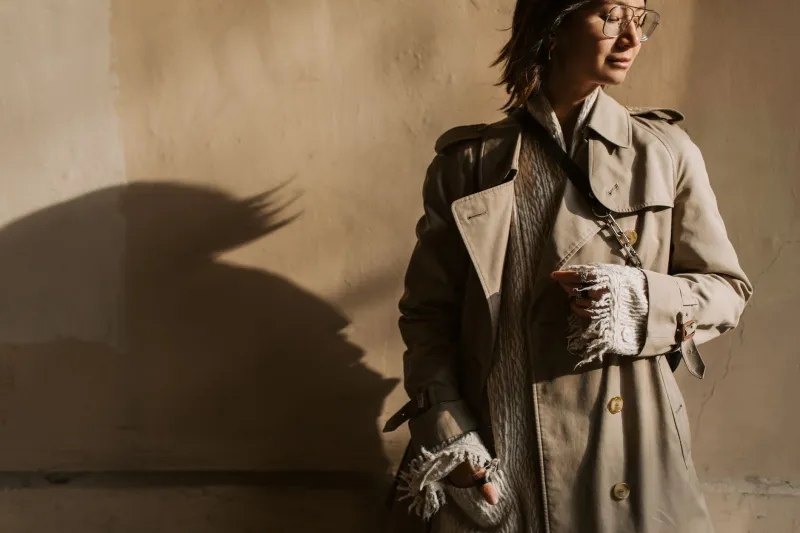
Invest in the best versions of the things you already know you love. A beautifully made trench coat in a warm neutral. Trousers cut with enough precision that they require no alteration. A leather bag in a shade that complements everything you own. These are not boring choices. They are the choices that will still feel exactly right a decade from now.
The Quiet Rebellion
To dress outside the trend cycle is not to be indifferent to fashion. The women who do this most gracefully are often deeply interested in the craft of clothing — in construction, in fabric, in the history of silhouette. They simply decline to let the industry's quarterly urgency dictate their choices.
In this sense, timeless dressing is a genuine act of independence. It refuses the premise that style must be purchased anew each season to remain valid. It insists that a well-developed personal aesthetic has more value than any trend report. And it offers something the conveyor belt never can: a wardrobe that belongs, completely and unmistakably, to you.
That is not a small thing. In a world engineered to make you feel perpetually incomplete, knowing exactly who you are — and dressing accordingly — is perhaps the most elegant statement of all.